

After one month at the front, Cpl Hedley Percy Duncombe, of 11 Brook Street, Luton, was admitted to hospital suffering from shell shock and loss of memory. He had been continuously under shell fire all the time he had been in the trenches, and the terrible strain proved too much for his nerves.
He is the son of Mr and Mrs Duncombe, who are well known in the town, Mr Duncombe being organist at Park Street Baptist Church and a master at Surrey Street School.
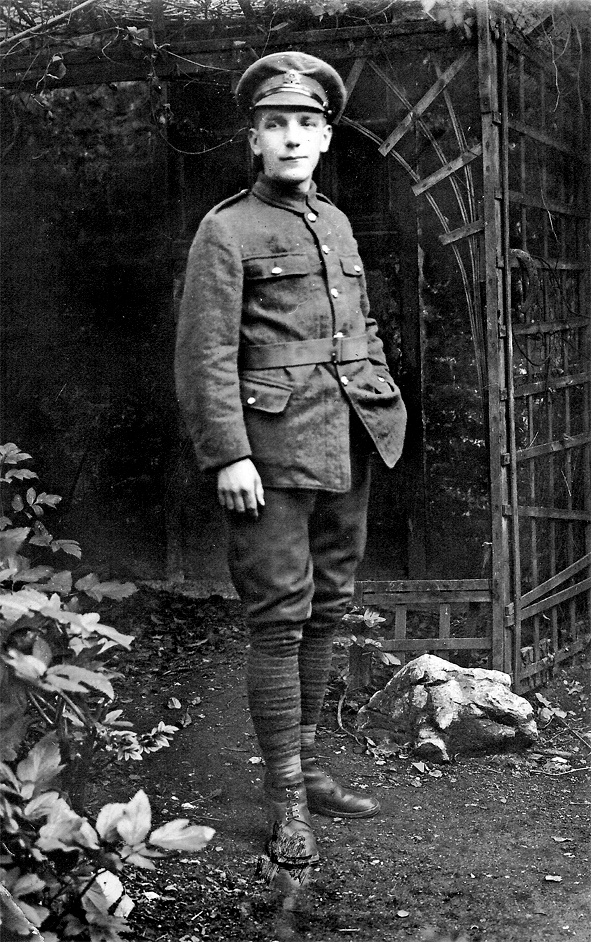 During the short time he was in France, Cpl Duncombe sent many cheery and interesting letters to his parents, extracts from a few are given below.
"...Snow! Yes, we have had plenty of it, but all is frozen now, so instead of living in mud and water, we are living on it. Have you ever really appreciated a wash and shave, father? Well, go without for 16 days, then walk five miles for water and, my hat, you'll enjoy your wash, I bet! I had one this morning and I feel a treat now. I did look a beauty, not half!
"On a 'table' before me lie about two dozen letters. The best of them are from home sweet home, so to you comes my first, though feeble attempt." After speaking of the irregular post outwards, Cpl Duncombe says:"What a blessing though. We get our letter from home delivered, even if we are only a few yards off Fritz..."
"...The Bath Room, eh! Our bathroom is practically a water can in a field, but I guess we can enjoy it as much as you do yours. How strange are what we might call relative values! The water-can swill here is as much appreciated as the lovely bath at home. It is strange, eh!
"We had a jolly rough time in the trenches - no blankets, and no shelter at all, night or day, for seven days. Then we changed trenches, and were just enough to get a little dug-out. One daren't have fires because Fritz would soon put some 'Minnies' [Minenwerfer trench mortars] over and put them out (and perhaps us too). We had to keep moving to keep warm, but I think everyone got a touch of frostbite. However, after a long march we are quite OK again, so don't worry."
Referring to his father's letters he says: "I love these little talks, however short they are. You must not worry about me - I always make the best of any and everything, and that is the secret of happiness.
"You cannot picture, and I cannot paint, what life is like up the line, but I shall be able to tell you after the war. It's no 'bon,' I can tell you! But now it is different. Far, far from the fighting we are enjoying a rest right in the country in an old broken-down farm. As we lie down at night we get a splendid chance of studying the stars - and I think perhaps you may be looking up at those same stars from the garden or study window."
Talking of some vermicide sent to him, he says: "If the vermicide is what you say it is, it will be a godsend to us, as these 'companions' are far too sociable for our liking. You might think us a special kind of monkey as we lie on our straw and search for these visitors. What a game! Still, it might be far worse."
Later, Cpl Duncombe writes: "I have had some marvellous escapes up the line, as things were rather lively where we were, but I didn't get the 'wind up' a little bit. I absolutely felt a protecting force around me. Once a huge shell dropped three yards from me and bounced right over my head, and then dropped near me again without exploding. Some people will tell you prayers are not answered. How can they possibly say so? This is only one of the escapes I have had...
"My thoughts have been of you all day long, and this afternoon I could picture you writing to me, father. Yes, I was struggling across field six inches deep in mud, and whilst others were grumbling about the dirt, I was happy at home, far away in Brook Street.
"In our billet tonight we had a lovely little meeting. Can you picture our happy little throng in a small ruined loft with half a roof and only two walls? The one little candle was blown out by the wind, and from below came the mules' voices, but God was there and we had a glorious time.
"At the other end of the loft was another party, bigger than ours, and these seemed to be enjoying a gamble, but I know which party was truly and honestly the happier and which went to bed with more comforting thoughts."
In another letter Cpl Duncombe writes: "Life out here is an experience that in after years we shall look back upon as - well, as a trip to the Continent. At the same time I might mention it is the last one I want to have for I, like all my comrades, have seen quite enough of the Continent."
In another letter he writes: "Everywhere I look I see dirt frozen hard like rock, except in the heavens above, where the sun is radiant, and his rays are brightening our world of tunnels, trenches and dug-outs. I broke a tin of ice up this morning and thoroughly enjoyed a wash and shave in it.
"Oh! Here's breakfast! Fritz has got our range, so bacon is not cooked. Well biscuits and cheese are quite good for hungry appetites, and we are in for a treat for tea - dates and biscuits.
"By jingo, it is cold! We can't sleep much - no blankets, you know. But I get up and have a good run and then tuck myself up in my top coat and sleep till I get cold again. Still, it's splendid training, and a guaranteed preventative against consumption, I hear."
Theses are only a few characteristic extracts, but they serve to show how the boys "out there" keep smiling faces through all their perils and hardships.
[Beds & Herts Saturday Telegraph: March 31st, 1917]