

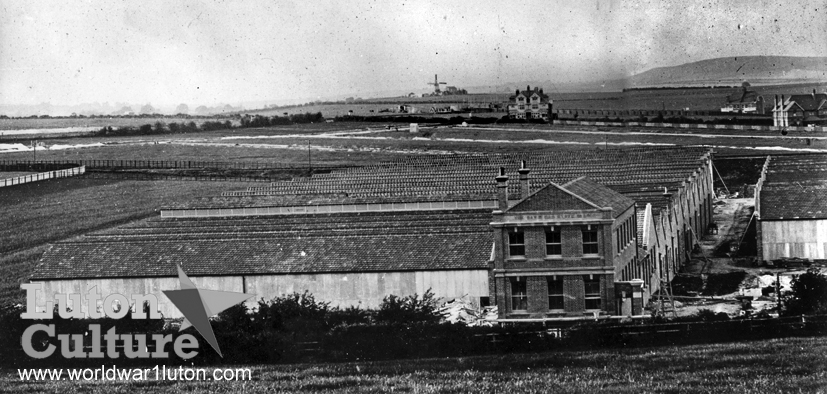
The Davis Gas Stove factory (Diamond Foundry) before in WW1 becoming a munition works.
The action of thousands of engineers in Luton's munition works in downing tools for a day to protest over what they saw as unfair food distribution in the town produced letters from those who thought thet should be serving khaki, and those who came to their defence as doing work of national importance and were not, as claimed in a letter in the previous edition of the Saturday Telegraph, "hundreds of well-fed, over-dressed, plump young pigeons who were out on strike for more food". This letter in The Luton News of February 7th, 1918, spoke up for the munition workers:
I have read with considerable interest and in some instances with disgust the letters from various correspondents on the action of the munition workers and others who attended the parade to protest against the unfair and unequal distribution of food that up to then caused such intense dissatisfaction in the town and surrounding district.
In perusing the letters in the local Press, one is struck by the almost unanimous similarity of view expressed by the writers, views in some cases whose narrowness is only exceeded by a colossal ignorance of munition and anything connected with the subject.
Apparently the majority view the action entirely from their own personal and in most cases selfish standpoint. Apparently their objections to the action are that they or their wives must either line up in the queue and share equal chances with others who go without.
One writer takes exception to the fact that people who have dealt with their butcher year in and year out will now be compelled to take their share in waiting for food. Where does the fairness in this come in? Isn't it more unfair that the wife of a munition worker should stand for several hours waiting to procure food for her family and then at the end be told that there is none for her, whilst hanging round the shop are a number of joints ready to be delivered to straw hat manufacturers whose only ground for preferential treatment is that they have always ordered their meat there?
Are some of these correspondents aware that a great many munition workers had been existing on bloaters, alternating with corned beef, while the local inhabitants of the town had preferential treatment in the way of prime cuts of beef and mutton? This is in striking contrast to the tale of munition workers who have been able to procure three meat meals a day and then went home expecting another. I have yet to learn where this famous canteen exists where such luxury prevails. I am afraid that its existence is in someone's very vivid imagination. If it does exist, let the matter be brought to light and dealt with fearlessly.
One brilliant light suggests that some women haven't the cheek to push their way into a queue to procure food. I entirely agree with him. I know several personally who wouldn't think of standing in a queue to procure food; they would rather go without their dinner. Yet quite a number of these same women were to be seen waiting in a queue one morning last week at a sale at one of the leading drapery establishments of the town.
Yet which is the better woman of the two, the one who has the cheek to stand in wet and icy slush at a temperature about freezing, or the other who is prepared to see her family go hungry and is yet prepared to brave the elements for finery? I plump for the true woman every time.
I think every man owes a debt of gratitude to the women who, perhaps feeling far from well, wait to procure the food to keep the men folk fit to do their share of the country's work.
There is one little point that some of the correspondents are most emphatic in expressing, namely, that they are not munition workers. Is this a matter to be proud of? I think not.
There are three classes of people who at the present time when we are fighting, not for our ideals, but for our very lives and existence, who really matter - our fighting men, our food producers and our despised munition workers. Obviously from their letters, these correspondents do not come into the above categories. Therefore one is tempted to ask what have they done, what are they doing, and what are they going to do when their country needs them so badly?
One has only to look at the Situations Vacant column of the local papers concerning the staple trade of the town, and the answer is pretty obvious. There is little indeed to be proud of "that they are not munition workers". Being proud of the fact that I am a munition worker and doing the little bit that lies in my power to assist our country, I am not ashamed to sign my name in full. James W. Seers, 17 Highfield Road, Luton.